What Is a Conceptual Data Model? Examples and 7 Steps
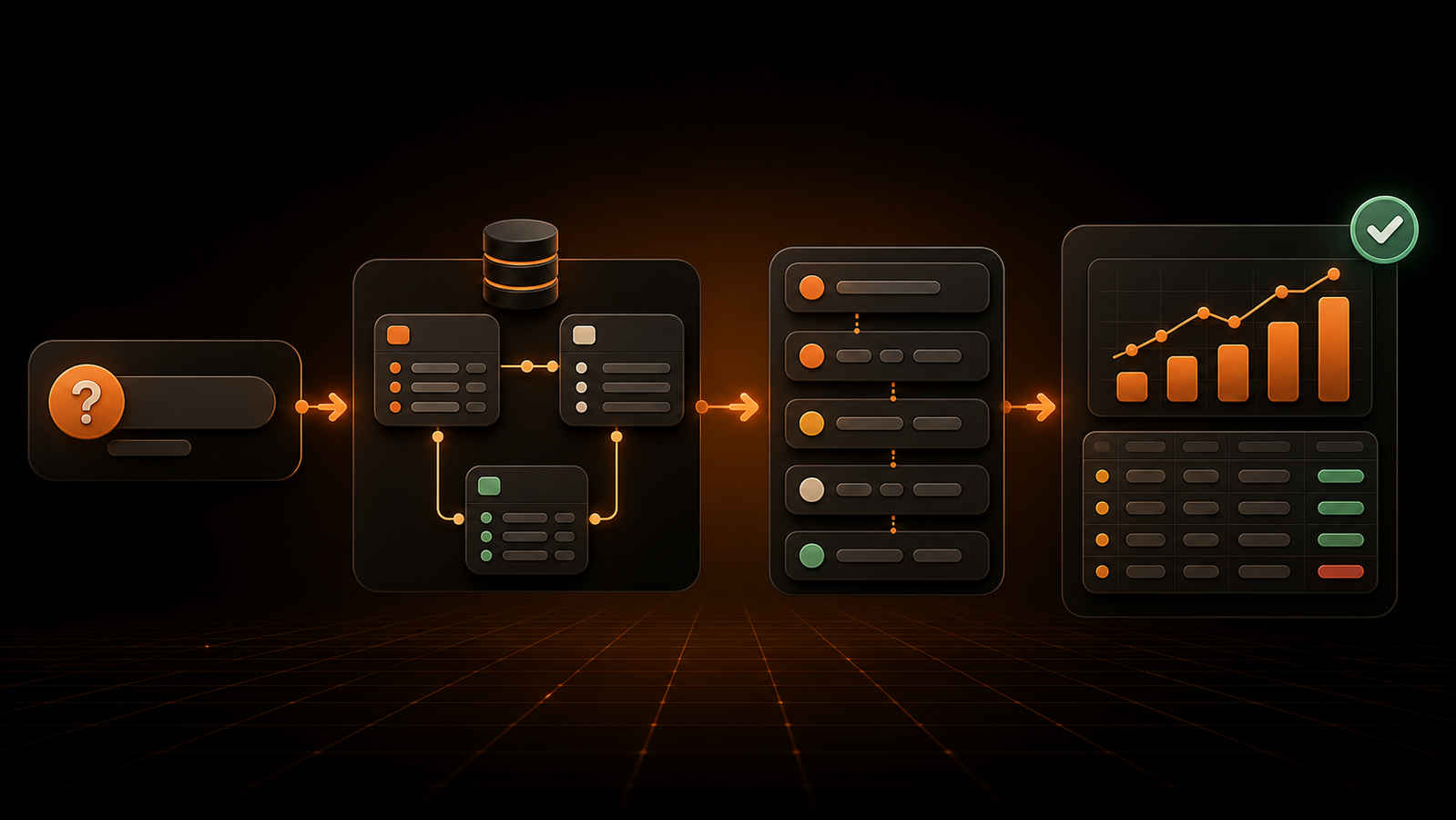
When teams jump straight from a business request to tables and columns, they often build a technically valid database that answers the wrong questions. A conceptual data model prevents that mismatch by defining the business concepts, relationships, and rules everyone must agree on before implementation begins.
When teams jump straight from a business request to tables and columns, they often build a technically valid database that answers the wrong questions. A conceptual data model prevents that mismatch by defining the business concepts, relationships, and rules everyone must agree on before implementation begins.
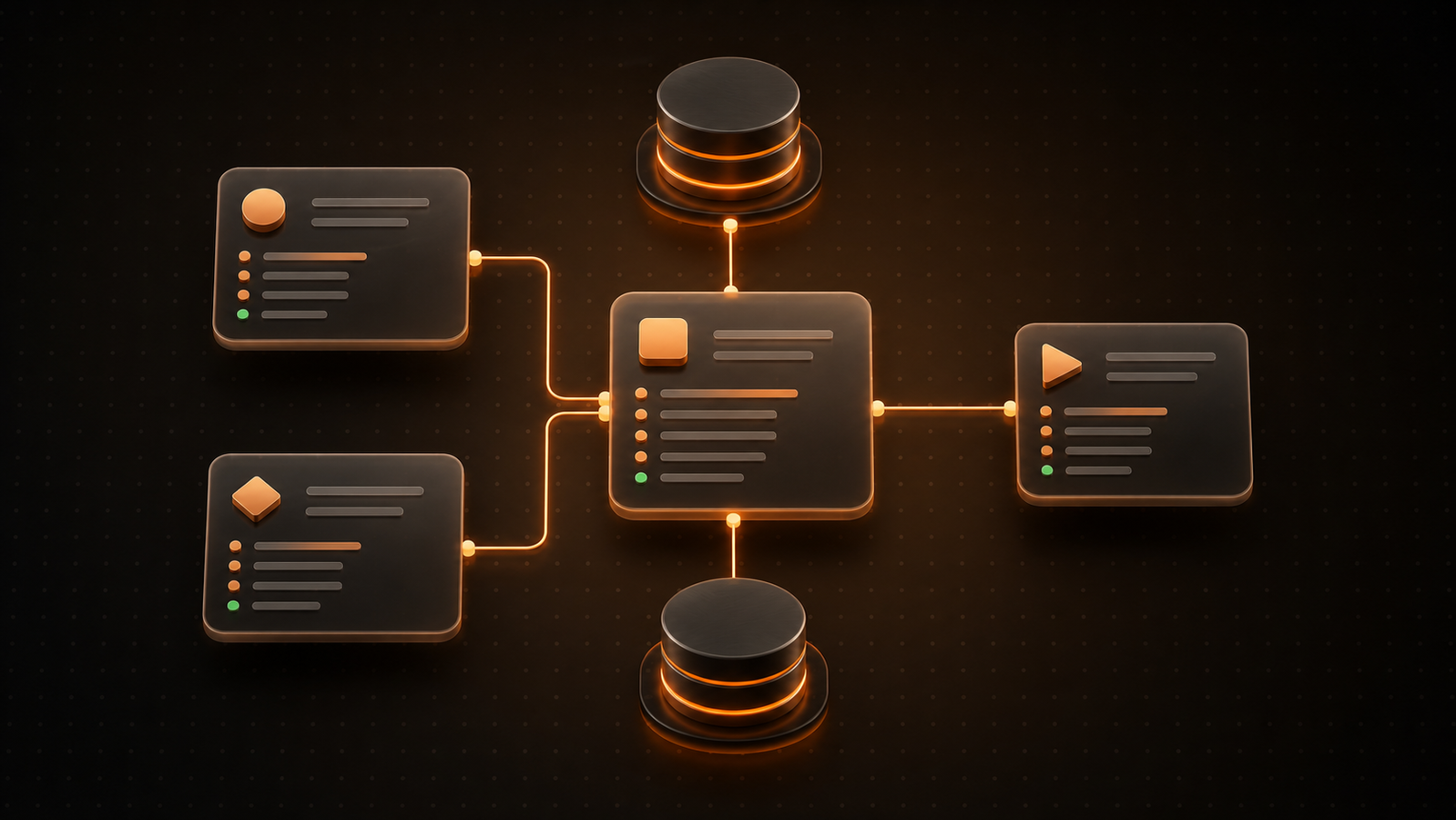
A conceptual data model is a high-level, technology-independent map of the important things a business needs to understand and how those things relate. It describes what the data means—not which database will store it, which columns it needs, or how queries will run.
This guide shows what belongs in the model, what does not, and how to build one around real business questions. It also includes a retail example you can adapt for SaaS, finance, healthcare, logistics, or another domain.
What is a conceptual data model?
A conceptual data model is a visual representation of a business domain. It names the major entities—such as Customer, Order, Product, or Store—and connects them with relationships and high-level business rules.
The model is deliberately simple. A founder, operations lead, analyst, and data architect should all be able to review the same diagram and discuss whether it reflects reality. IBM describes conceptual models as domain models created while gathering initial requirements, before the work becomes more concrete in logical and physical models (IBM's data modeling guide).
A useful conceptual model answers four questions:
- What business questions are in scope?
- Which real-world people, places, things, events, or concepts matter?
- How are those concepts related?
- Which rules must remain true for the model to make business sense?
It should not yet settle table names, column types, indexes, partitions, or vendor-specific features. Those decisions belong downstream.
Conceptual data model vs. conceptual schema
The terms are often used interchangeably. In some database literature, conceptual schema means the formal organization-wide view of data, while conceptual data model may also refer to the diagram or modeling artifact used to express that view.
For practical project work, the distinction matters less than the outcome: a shared, implementation-neutral definition of the domain. Keep the artifact accessible enough for business stakeholders to validate.
Why a conceptual data model matters
The value is not the diagram itself. The value is the conversation the diagram makes possible before expensive implementation choices harden.
It creates a shared business language
“Customer” may mean an account to Sales, a billing entity to Finance, and an individual user to Product. A model forces the team to decide whether those are one concept, different concepts, or related concepts with distinct definitions.
That vocabulary is a governance asset. The Object Management Group's SBVR guidance emphasizes that business participants need shared, exact meanings for the terms they use, while DAMA maintains a standardized data-management dictionary to support consistent terminology (OMG on business vocabulary, DAMA Dictionary of Data Management).
It exposes missing rules early
A line between Customer and Order is not enough. Can an order exist without a customer? Can one order include products from multiple sellers? Can a customer belong to more than one account? These questions reveal assumptions that would otherwise surface during development—or after reports disagree.
It controls project scope
The model makes inclusion and exclusion visible. If a first release needs to analyze orders by product and store, entities for supplier contracts or warehouse maintenance may be valid business concepts but outside the current boundary.
It gives downstream teams a stable reference
Logical schemas, APIs, operational databases, warehouses, semantic layers, and dashboards may implement the same concept differently. A conceptual model provides the common reference they can map back to as systems change.
Conceptual data model vs. logical and physical models
Conceptual, logical, and physical models are not competing diagram styles. They answer different questions at increasing levels of detail. IBM describes the usual progression as conceptual first, logical second, and physical last (IBM).
| Model | Primary question | Typical contents | Primary audience | Technology-specific? |
|---|---|---|---|---|
| Conceptual | What does the business need to understand? | Core entities, relationships, scope, high-level rules | Business stakeholders, analysts, architects | No |
| Logical | How should the information be structured? | Attributes, identifiers, detailed cardinality, normalization, constraints | Data modelers, analysts, architects | Usually no |
| Physical | How will it be implemented? | Tables, columns, data types, keys, indexes, partitions, storage settings | Engineers and database administrators | Yes |
For example, a conceptual model may say Customer places Order. The logical model adds Customer ID, Order Date, an identifier strategy, optionality, and detailed relationship rules. The physical model turns those decisions into PostgreSQL tables, Snowflake objects, MongoDB documents, or another implementation.
The boundaries are not perfectly universal. Some conceptual models show a few important attributes or identifiers; others show only entities and relationships. The right test is whether a detail helps stakeholders validate business meaning. If it exists mainly to satisfy a database engine, it is too physical for this stage.
Core components of a conceptual data model
Most conceptual models need five ingredients. Keeping them explicit makes the diagram easier to review and harder to misinterpret.
1. Business questions and scope
Start with decisions or questions, not nouns. “Which stores lose repeat customers after a late delivery?” is a stronger anchor than “model our retail data.” It tells you that Customer, Order, Store, Delivery, and time-related events may matter.
HURIDOCS recommends clarifying database goals and queries before designing the model, then using those queries to identify necessary entities and relationships (HURIDOCS conceptual modeling guide). This query-first approach keeps the model tied to use rather than organizational complexity.
2. Entities
An entity is a distinguishable business concept the organization needs to track or reason about. Common categories include:
- People or organizations: Customer, Employee, Supplier
- Places: Store, Region, Warehouse
- Things: Product, Subscription, Asset
- Events: Order, Payment, Shipment, Support Interaction
- Agreements or classifications: Contract, Plan, Category
Use singular business names. Prefer Order to Orders table and Customer to Customer record. The entity represents the concept, not its storage container.
3. Relationships
Relationships state how entities participate in the business. Name them with verbs so the diagram can be read as sentences:
- Customer places Order
- Order contains Product
- Store fulfills Order
- Payment settles Order
Verb phrases expose vague thinking. “Customer—Order” could mean places, pays for, receives, cancels, or owns. Each interpretation may imply a different rule.
4. Cardinality and optionality
Cardinality states how many instances may participate: one-to-one, one-to-many, or many-to-many. Optionality states whether participation is required.
For example, one Customer may place many Orders, while each Order must be placed by one Customer. Microsoft uses 1 and * to distinguish unique and repeated sides of a model relationship, a notation that also makes conceptual diagrams easy to scan (Microsoft's relationship documentation).
At this stage, capture cardinality only when it expresses a real business rule. Do not infer it from the current contents of a spreadsheet.
5. Definitions, rules, and assumptions
A diagram cannot carry every nuance. Pair it with a compact glossary and rule list:
- Customer: a person or organization eligible to place an order
- Completed Order: an order fulfilled and not fully refunded
- An Order must contain at least one Product
- A Payment may settle one or more Orders
- Marketplace sellers are outside the first-release scope
Record unresolved items as assumptions or questions instead of silently choosing an answer.
Conceptual data model example: retail orders
Suppose a retail team needs to answer three questions:
- Which products drive repeat purchases?
- How does fulfillment location affect delivery time?
- Which customer segments have the highest refund rate?
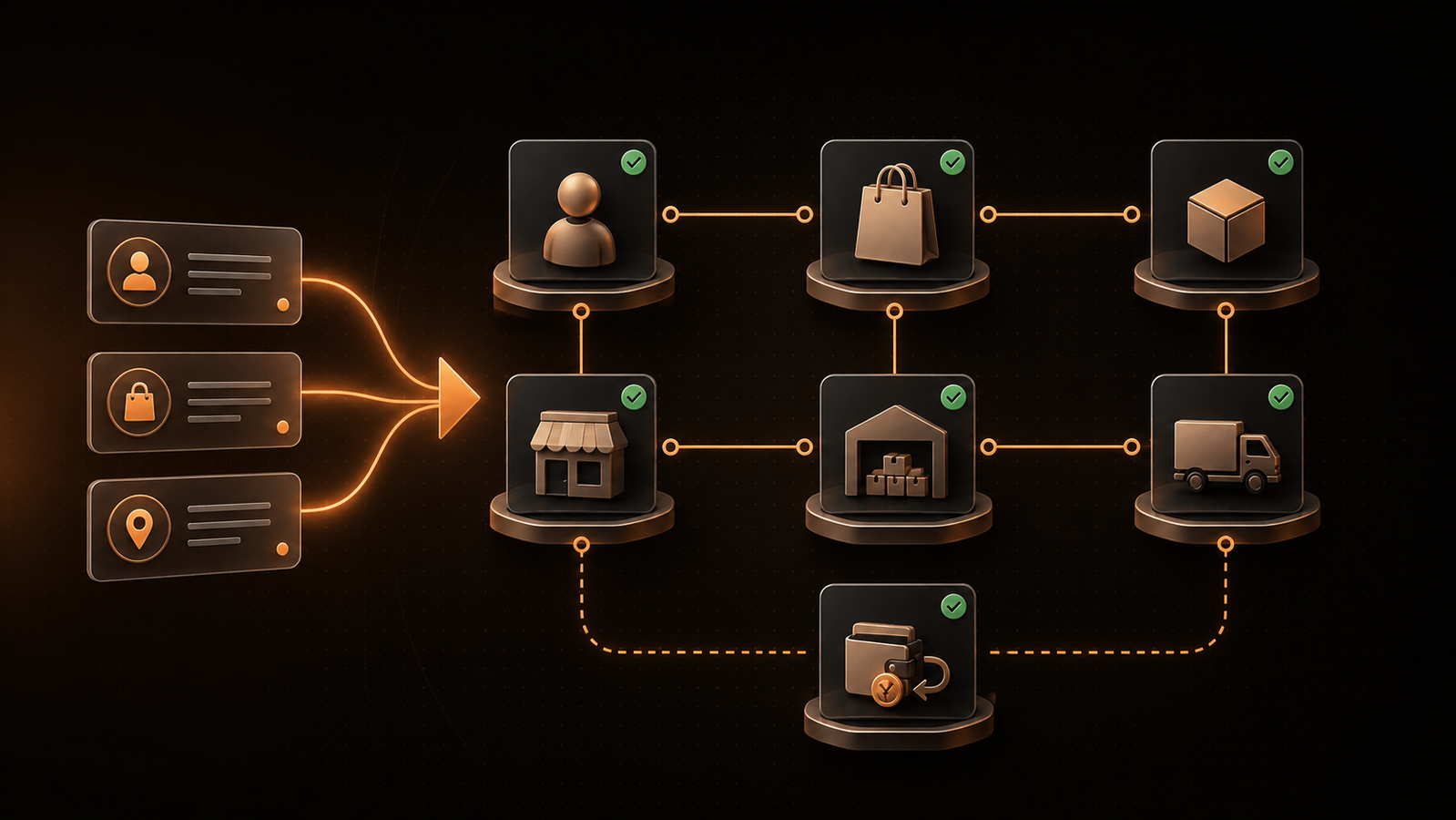
A first conceptual model could contain these entities:
| Entity | Business meaning | Why it is in scope |
|---|---|---|
| Customer | Person or organization buying products | Repeat behavior and segmentation |
| Order | Commercial purchase event | Connects customer demand to fulfillment |
| Product | Item offered for sale | Product performance |
| Store | Physical or digital selling location | Order origin and channel analysis |
| Fulfillment Location | Place that prepares an order | Delivery performance |
| Delivery | Movement of an order to its destination | Delivery time and status |
| Payment | Financial settlement event | Paid, failed, or refunded outcomes |
| Refund | Reversal of all or part of a payment | Refund-rate analysis |
The relationships might read:
- Customer places Order: one customer may place many orders; each order has one purchasing customer.
- Store receives Order: one store receives many orders; each order originates from one store.
- Order contains Product: an order contains one or more products; a product can appear in many orders.
- Fulfillment Location fulfills Order: one location fulfills many orders; the first release assumes one location per order.
- Order results in Delivery: an order may have no delivery for pickup, or one delivery under the first-release assumption.
- Payment settles Order: the relationship remains a workshop question if split payments are possible.
- Refund reverses Payment: a payment may have zero or more refunds.
Notice what is absent: VARCHAR(255), foreign keys, bridge tables, API fields, and warehouse dimensions. The model captures a deliberate simplifying assumption—one fulfillment location per order—and flags split payments for validation. That is exactly the kind of ambiguity a conceptual workshop should surface.
How to create a conceptual data model in 7 steps
The best working sessions move from questions to concepts, then test the model against real scenarios. A whiteboard or diagramming tool is sufficient; facilitation quality matters more than specialized software.
Step 1: Define the decision and boundary
Write one sentence describing the decision, process, or product capability the model must support. Add two lists: explicitly in scope and explicitly out of scope.
For the retail example, the boundary might include orders, products, fulfillment, delivery, payment, and refund. Supplier procurement and workforce scheduling stay out. A boundary prevents the workshop from turning into a map of the entire company.
Step 2: Collect representative business questions
Ask each stakeholder for questions they need the data to answer. Favor specific prompts such as “What percentage of first orders are refunded within 30 days?” over broad requests such as “show customer performance.”
Include normal cases and exceptions. Cancellations, partial refunds, guest checkout, merged accounts, split shipments, and backorders often reveal the relationships that a happy-path model misses.
Step 3: Identify candidate entities
Underline the important nouns in the questions and process descriptions, then separate durable concepts from mere labels or attributes. A candidate is more likely to be an entity when it:
- has meaning independent of another concept;
- has its own lifecycle or rules;
- participates in several relationships; or
- needs attributes of its own later.
Do not promote every noun. “Order status” may be a controlled classification rather than a full entity. “Age” is usually a derived attribute, not a person or event.
Step 4: Define each entity in business language
Write a one-sentence definition, an example, and a non-example. If stakeholders cannot agree on the definition, keep the disagreement visible.
This step catches overloaded terms. An “Account” might mean a login container, a contracted company, or a financial ledger. Those concepts may need different names and relationships.
Step 5: Connect entities with verb phrases
Draw the minimum relationships needed to answer the business questions. Read each connection aloud as a sentence. HURIDOCS suggests a simple noun–verb–noun structure and recommends keeping relationships as simple as possible while still answering the target questions (HURIDOCS).
Avoid unlabeled lines and generic verbs such as “has” when a specific action exists. “Order has Payment” hides whether a payment authorizes, settles, refunds, or fails an order.
Step 6: Add cardinality, optionality, and key rules
For each relationship, ask four questions:
- Can one A relate to many Bs?
- Can one B relate to many As?
- Can A exist without B?
- Can B exist without A?
Write the answer as a rule and test exceptions. If one order can be fulfilled from several warehouses, a one-location assumption is wrong even if current data happens to show only one.
Step 7: Validate with scenarios and owners
Walk through at least three normal scenarios and three edge cases using concrete examples. Confirm that every target question can be traced through the entities and relationships.
Assign a business owner to approve each definition and major rule. Then version the artifact, record open questions, and schedule a review when the process or product changes. IBM recommends treating data models as living documents that evolve with business needs (IBM).
Validate the model before adding technical detail
Use this checklist at the end of the workshop:
- Question coverage: Can the model represent the facts needed for every in-scope question?
- Business readability: Can a domain expert explain it without database terminology?
- Definition quality: Does each entity have one clear meaning, with synonyms resolved?
- Relationship clarity: Is every line named with a meaningful verb?
- Rule accuracy: Are cardinality and optionality based on policy and edge cases, not sample data?
- Scope discipline: Are excluded domains and future ideas recorded separately?
- Ownership: Is someone accountable for disputed definitions and rules?
- Technology independence: Could the model survive a change from one database or application to another?
- Traceability: Can logical models and analytics terms later point back to these concepts?
If the model fails a test, refine the concept rather than adding columns to hide the ambiguity.
Common conceptual data modeling mistakes
Starting from an existing database
Reverse-engineering a schema can reveal what a system stores, but it does not prove that the system represents the business correctly. Begin with business questions, then compare the resulting model with existing systems to identify gaps.
Mixing levels of abstraction
A diagram containing Customer and Order beside order_line_id BIGINT is trying to serve business and implementation audiences at once. Maintain linked conceptual, logical, and physical views instead of one overcrowded artifact.
Treating attributes as entities—or entities as attributes
The decision depends on use. If the business only needs a store name on an order, Store might begin as an attribute. If it needs store region, opening date, manager, channel, and fulfillment relationships, Store deserves entity status. HURIDOCS offers the same practical test: concepts that are important units of analysis with properties of their own are strong entity candidates (HURIDOCS).
Modeling the organization chart instead of the domain
Departments change. Customer, Order, Claim, Shipment, and Contract often persist. Organize the model around stable business meaning rather than current team ownership.
Skipping uncomfortable exceptions
Many-to-many relationships, missing identifiers, shared accounts, and retroactive corrections are not workshop distractions. They are evidence about how the business works. Record the ambiguity even if the final rule requires a policy decision.
Declaring agreement without scenario testing
Stakeholders may agree with a clean diagram until they try to represent a refund after a split shipment. Concrete scenarios turn apparent agreement into meaningful validation.
Use AI as a modeling assistant, not the model owner
AI can summarize requirements, propose candidate entities, identify inconsistent definitions, or generate a first-pass diagram. It is most useful for accelerating preparation and surfacing questions.
It should not approve the model. A 2026 study of LLM-generated entity-relationship diagrams found that reliability decreased as requirements grew more complex, with more inconsistencies, ambiguity, and failures to represent constraints (Siqueira et al., 2026). The authors suggest narrower support tasks, including identifying ambiguity, rather than asking one system to perform the entire modeling workflow.
Keep domain owners responsible for definitions, exceptions, and policy. Require the same scenario-based validation whether the first draft came from a person or an AI tool. The governance principles in this process also complement a broader AI governance program when generated artifacts influence production systems.
Move from conceptual model to usable analytics
Once stakeholders approve the conceptual model, the data team can add attributes, identifiers, constraints, and normalization in a logical model. The physical design then maps those decisions to the chosen operational database, warehouse, or lakehouse; layered architectures can further organize data quality and consumption stages, as described in this guide to bronze, silver, and gold data layers.
The conceptual vocabulary should also carry into metrics and dashboards. If the model defines “completed order” and distinguishes purchasing Customer from billing Account, the semantic layer should preserve those meanings rather than re-invent them report by report.
This is where GetInsights can help teams use an implemented model: it connects directly to an existing database and turns plain-English questions into read-only SQL, charts, and dashboards. The conceptual model does not replace the live schema, but its shared vocabulary gives business users and analysts a clearer basis for asking and validating questions against that data.
You are ready to move into logical design when:
- the scope and core business questions are agreed;
- entity definitions are understandable and owned;
- relationships, cardinality, and optionality survive edge-case testing;
- important assumptions and unresolved policy decisions are documented; and
- stakeholders can trace each required question through the model.
Frequently asked questions
What is an example of a conceptual data model?
A retail conceptual model might show Customer, Order, Product, Store, Delivery, Payment, and Refund. It would connect them with business relationships such as “Customer places Order” and “Refund reverses Payment,” without specifying SQL tables or column types.
What is the difference between a conceptual and logical data model?
A conceptual model defines the important business concepts and how they relate. A logical model adds structural detail such as attributes, identifiers, normalization, detailed constraints, and relationship implementation while usually remaining independent of a specific database product.
Does a conceptual data model include attributes?
It may include a few high-level attributes when they help stakeholders distinguish or validate a concept, but detailed attribute lists usually belong in the logical model. The conceptual view should remain readable and focused on business meaning.
Is a conceptual data model the same as an ER diagram?
Not exactly. An entity-relationship diagram is a notation that can represent a conceptual, logical, or physical model. A conceptual data model is defined by its business-level scope and abstraction, not merely by using boxes and connecting lines.
Who creates and approves a conceptual data model?
Business analysts, product owners, data architects, and domain experts commonly create it together. Business owners should approve meanings and rules, while data professionals ensure the model is coherent and can support later design work.
What tools can I use to create one?
A whiteboard, shared diagramming application, or dedicated data-modeling tool can all work. Choose a tool that makes collaboration, versioning, definitions, and review easy; the quality of the questions and validation matters more than the software.
Conclusion
A conceptual data model is successful when it makes business meaning explicit before technical design begins. Start with the decisions and questions the model must support, define a small set of owned entities, connect them with precise relationships, and test the result against normal and exceptional scenarios.
If your team can explain the diagram in business language and trace every in-scope question through it, proceed to logical design. If definitions or rules still shift depending on who is in the room, schedule another modeling workshop before building—and use the retail example and validation checklist above as your agenda.
Ask your data a question instead
Connect your database and ask in plain English. GetInsights writes the SQL, runs it read-only, and hands you the chart and dashboard.
Start for free